
Harvey County Court Records After Arrest
Harvey County court records after a jail arrest are not the same thing as the jail roster. The roster reflects custody, booking time, booking photo, charges entered by jail staff, bond groupings, next court dates, and holds. The court case is the formal record that follows once the prosecutor files charges. Harvey County District Court is part of the Ninth Judicial District with McPherson County, and the court is on the second floor of the Harvey County Courthouse.
The Harvey County Attorney's Office is the local prosecution office. The official county attorney page names Heather Figger as County Attorney and says the office prosecutes felony offenses committed in Harvey County and misdemeanors occurring in rural Harvey County. That prosecutor role is why a booking charge and a filed court charge may not match. A booking entry may reflect an arrest statute, a warrant, or an initial jail classification, while the court record reflects the screened charge filed into the case.
For custody and booking fields, use Harvey County jail inmate records. For booking photos, use Harvey County jail mugshots. For filed charges and case events, use Kansas CaseSearch, the Harvey County District Court clerk, and hearing-calendar tools.
Search Court Records After Arrest
Kansas provides a statewide public portal, Kansas CaseSearch, for district court records. Official descriptions state that users can search by case number, party name, business name, citation, or other criteria available to the user's role. That makes CaseSearch the starting point after a Harvey County jail arrest when the goal is to find the filed case rather than the custody card. The Kansas hearing calendar filtered to Harvey County can also help confirm scheduled court activity.
- Start with the defendant's legal name from the jail roster or court notice.
- Search Kansas CaseSearch by party name, case number, or citation if one is available.
- Open the case result and compare filed charges with any booking charges shown on the jail roster.
- Check hearing dates, bond entries, disposition fields, and warrant-related events when the portal provides them.
- Contact the Harvey County District Court clerk for documents that are not available through the public portal.
The official Harvey County District Court source shown below comes from harveycounty.gov/district-court.
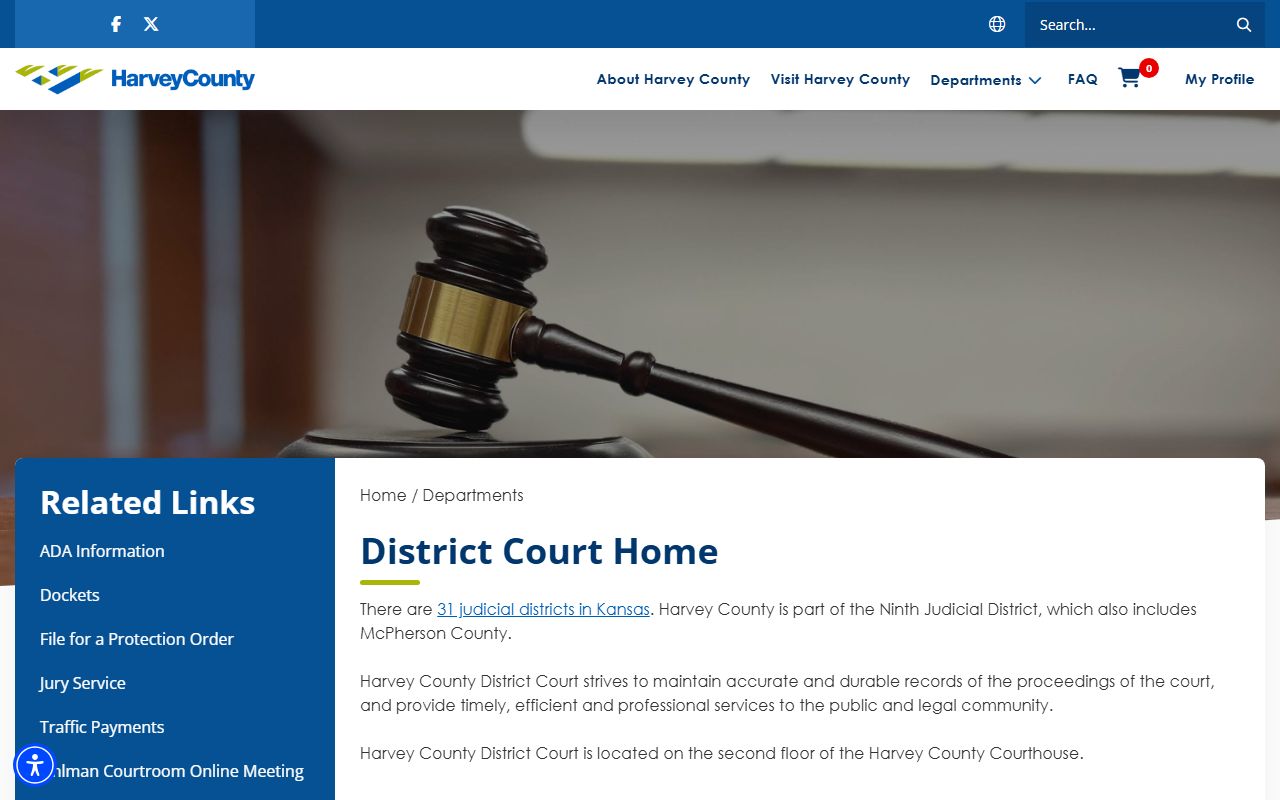
The district court page anchors the court side of the search, while the jail roster remains the source for current custody and booking data.
Harvey County Case Search Fields
Court records after a Harvey County arrest are easier to find when the case number is known, but a defendant-name search is often the first option. CaseSearch is statewide, so common names may return more than one county or case. Compare the county, filing date, charge text, and hearing events before assuming a match. If a new arrest has not produced a filed case yet, the case may not appear until prosecutor screening and court entry occur.
| Field Label | Type | Required | Notes |
|---|---|---|---|
| Case number | Text | No, unless using case-number search | Best when the booking record, citation, notice, or clerk provides the exact case number. |
| Party name | Text | No | Useful for defendant-name searches after a jail arrest. |
| Business name | Text | No | Used for cases involving business parties. |
| Citation | Text | No | Often useful in traffic or citation-based cases. |
| Role-specific criteria | Variable | Unspecified | Kansas courts note that other criteria may be available depending on the user's role and access. |
Charges Filed After Arrest
The arrest record is the start of the custody path. The charging document is the start of the court case. In Kansas practice, a complaint, information, or indictment may supply the formal accusation that the court tracks. Research for Harvey County did not locate a local page that lists every form by name, so the table uses the standard criminal-case terms referenced in the build instructions and keeps the key distinction clear: the prosecutor or grand jury process controls the filed court charge, not the jail roster card alone.
| Document | Who Uses It | What It Does |
|---|---|---|
| Complaint | Prosecutor or authorized charging authority | States the accusation that can begin a criminal case after arrest or investigation. |
| Information | Prosecutor | Lists formal charge counts after prosecutor review, often in felony practice. |
| Indictment | Grand jury process | Charges an offense through a grand jury accusation when that process is used. |
Booking charges can be amended, reduced, dismissed, or replaced. That is not unusual. A person may be booked on one statute while the final court filing lists a different charge level, count, or case number. Use the jail record for custody, and use the court record for the case that will be heard by the judge.
Harvey County Charge Status
Charge status tells where a filed count stands in the court process. A pending charge is an accusation, not a conviction. A dismissed charge means the count is no longer being pursued in that case. An amended charge means the filed count changed. A disposition is the outcome, such as dismissal, plea, verdict, or sentencing. These terms should be read with the case docket, because one case can have multiple counts with different outcomes.
| Status | What It Means |
|---|---|
| Pending | The charge is active and has not reached final disposition. |
| Amended or reduced | The filed charge changed, often after prosecutor review, plea talks, or court order. |
| Dismissed | The charge count is no longer moving forward in that case. |
| Convicted | The case has a guilty plea, verdict, or other conviction disposition for that count. |
| Warrant or failure to appear | A court event may have led to a warrant, booking, bond change, or hold. |
Bond After Harvey County Arrest
Bond is part custody record and part court record. Harvey County says a suspect's charges and bond amount can be acquired by contacting Detention Center staff. The county roster also shows bond type values such as SURETY, CASH, and NO BOND, grouped by bond number. Under K.S.A. 22-2802, appearance bonds and required security are deposited with the magistrate or clerk of the court where release is ordered.
| Bond Type | How It Works |
|---|---|
| Cash bond | Money is deposited as ordered by the court for release. |
| Surety bond | An approved bonding agent posts the bond under court and district rules. |
| PR bond | A promise-to-appear release may be ordered without the same cash deposit. |
| No bond | No release amount is listed for that charge or hold. |
| Hold or detainer | Another court or agency may keep the person in custody even after one bond is addressed. |
Do not confuse JailATM account funds with release bond. Harvey County documents JailATM for inmate account deposits, but release bond follows the court order and approved bonding process.
Warrants and Arrest Records
No official Harvey County sheriff active-warrant search was located in the research. The county jail roster can show warrant-related information after a person is booked, including failure-to-appear charge descriptions or hold details. Holds may include a holding authority, case number, comments, hold date, or clearance information. City or municipal bench warrants may not appear on the county roster until served and booked.
A careful warrant check uses more than one source. Call the sheriff or jail for custody questions, check Kansas CaseSearch for filed court cases and failure-to-appear activity, contact the relevant municipal court for city ordinance matters, and consider legal advice before walking into an agency on a suspected active warrant. Newton Police also publishes daily bulletin PDFs for arrests and incidents, but those bulletins are not a county warrant database.
Charges vs Convictions
Harvey County court records after a jail arrest may show charges long before any final outcome. A charge is an accusation filed in court. A conviction is a result based on a guilty plea, verdict, or other conviction disposition. The difference is important for readers, employers, landlords, and anyone trying to understand a case. A person can be arrested and charged without being convicted.
| Point | Charge | Conviction |
|---|---|---|
| Stage | Accusation after arrest or investigation | Final or case-level outcome for a count |
| Proof | Not proof of guilt | Based on plea, verdict, or court finding |
| Record meaning | Shows what was filed | Shows the adjudicated result |
Expunged Harvey County Records
Kansas provides expungement paths for certain convictions, arrest records, and diversion agreements. K.S.A. 21-6614 covers expungement of certain convictions, arrest records, and diversion agreements. K.S.A. 22-2410 addresses arrest-record expungement procedure. Eligibility depends on the case, offense, time period, and outcome, so the court record should be checked against the statute and any court order.
| Point | Sealed or Restricted | Expunged |
|---|---|---|
| Public access | Public access is limited by court rule, statute, or order. | The record is handled under the expungement order and Kansas law. |
| How it happens | Often tied to a protected case type or court restriction. | Requires a statutory expungement process or order. |
| Best source | District court clerk or case docket. | The court file, order, and applicable Kansas statute. |
Open Court Records Limits
Kansas public-records law starts with openness. K.S.A. 45-216 states the public policy that public records are open unless otherwise provided by law. K.S.A. 45-218 governs inspection requests, response, refusal, and fees. K.S.A. 45-221 lists records an agency is not required to disclose.
Those public-record rules do not make every court or arrest-related item visible online. Juvenile matters, sealed records, expunged records, protected victim information, active investigative material, and some agency-held arrest reports may be restricted. The Kansas Attorney General's KORA FAQ also states that mug shots and standard arrest reports are not required to be open and may be discretionarily closed under K.S.A. 45-221(a).
Important: Court records and casual lookups are not consumer reports and should not be used for FCRA-covered decisions.